

Move fast and fix things!
Growth is hard. Unintended consequences are inevitable. What can we learn from history so that we aren't doomed to repeat it?

“Start-ups are to corporations what meerkats are to African wildlife: a little smaller, a little more fun, and definitely not threatening or predatory like a lion. The only problem is that every meerkat, deep in his heart, wishes he were a lion”
The idea of the company or corporation dates back to ancient Rome. Just like companies today, societas publicanorum were a group of people with special rights and privileges. The societas were also originally formed to benefit the common good. Their role was originally to collect taxes from the far reaches of The Republic. They evolved into all-purpose government sub-contractors, involved in everything from building aqueducts to the daily adminstration of government.
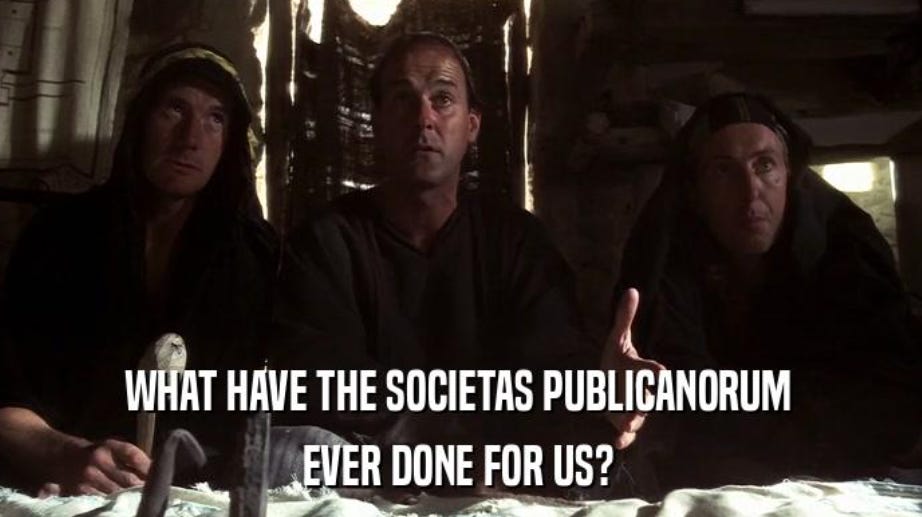
What have the societas publicanorum ever done for us? These where the organisations that collected taxes, managed government bueuracracy and organised great public works on behalf of The Republic.
But during the first century BC something went wrong. The societas began prioritising their own interests over the society they were formed to benefit. The corruption that followed is the first major lesson in private enterprise acting against the interests of broader society. The societas took too much risk, lobbied and bribed Senators, exploited and enslaved citizens and ultimately ran out of cash. After they had overextended themselves one too many times, the Roman Senate finally refused to bail them out. But by then, the societas had become ‘too big to fail’ and many historians believe this led directly to the alliance between Caesar, Pompey, and Crassus… and the end of The Republic.
‘[Societas] were the curse and the scourge of the conquered nations, largely responsible for the detestation of the Roman name among the subjects of Rome, and perhaps even for the downfall of the Roman Republic.’
The systemic risk created by the societas evolved over centuries. In contrast, modern companies can grow and scale frighteningly quickly. In fact, rapid growth is demanded by Silicon Valley venture capitalists, with a growth at all cost culture epitomised by the former Facebook motto, ‘Move fast and break things’. Whilst possibly light-hearted and rebellious in its intent, this motto has a serious edge. It promotes an ideology of ‘fail fast’ risk taking. The speed at which modern companies can now grow and scale means near infinite upside. But whilst growth can have societal benefits, a ‘growth at all costs’ culture breeds companies which do not think through (or care about) the consequences of growth.
Breaking things!
Zuckerberg: Yeah so if you ever need info about anyone at Harvard
Zuckerberg: Just ask.
Zuckerberg: I have over 4,000 emails, pictures, addresses
Friend: What? How’d you manage that one?
Zuckerberg: People just submitted it.
Zuckerberg: I don’t know why.
Zuckerberg: They “trust me”
Zuckerberg: Dumb f***s
Zuckerberg was a 19-year-old student when he had this interaction, so we should probably cut him some slack. But it also reminds us to be cynical when assessing the latest corporate mission statement. Was Facebook’s subsequent mission of ‘Connecting People’ real or just the most convenient narrative for a rapidly growing social network? And to what extent did Zuckerburg ever seek to balance the risks of growth, against the financial rewards?
‘Give people the power to build community and bring the world closer together’
Meta mission statement
The Meta mission today, for example, could easily be viewed ironically. Meta has billions of users and continues to rapidly deploy new features and structures, each of which has unintended social consequences. Privacy concerns, bullying, child abuse, vigilantes, terrorism, misinformation, political extremism and foreign interference in democratic elections are just some of the manifest risks. In reality, the consequences of Meta’s growth seems antithetical to its mission.
The invisible hand drops the ball
Meta is just one start-up. It has grown freakishly quickly and operates in an area that turns out to be very high risk from a social perspective. Many other start-ups over the last 20 years have had a hugely positive impact on the world. Yet, social media serves as an important example of what can go wrong if we are reckless with regards to the consequences of growth. I have highlighted many other painful examples in my recent writing (see Non-stick Nightmare, Is Fish Farming Sustainable and Big Questions for Big Food). Growth has costs - sometimes substantial costs - which are not magically solved by the market. In other words, ‘the invisible hand’ regularly drops the ball….. and whilst often conveniently forgotten, Adam Smith himself was well aware of this:
‘[The East India Company are] an order of men, whose interest is never exactly the same with that of the public, who have generally an interest to deceive and even to oppress the public, and who accordingly have, upon many occasions, both deceived and oppressed it.’
Suffice it to say, the pursuit of growth and profit does not always result in a benefit to society. Pursuing growth and profit can be a noble aim, but it is arrogant to suggest that the best thing a company can do for the world, is to grow as quickly as possible. Meta, on which billions of consumers now spend hours of their time every week, is the perfect example of a company which has grown too fast, broken too many things and still hasn’t been effectively restrained by society.
Having observed the role of the East India Company and other Joint Stock Companies in society, Adam Smith understood the limitations of market forces.

It took the Roman Republic centuries to respond to the corrupting effects of the societas. The UK Parliament took a century to effectively respond to challenges created by the ‘Joint Stock Company’. The US Congress took decades to respond to the Robber Barrons. Today, we face much faster moving challenges, created by companies that may be explicitly trying to break things… and they have been succeeding on a speed and scale that is unprecedented! Disruptive innovation is best when it accelerates the demise of unsustainable systems. Creative destruction is a healthy part of an progressive society. But if we aim to ‘grow at all costs’, we risk incurring costs that we cannot afford to bear.
This dynamic—innovation, exploitation, reformation—has played out over and over again in the history of corporations. When one looks at its evolution over hundreds of years of history, we get a remarkable picture of how the corporate infrastructure of today is laid on the bones of these historical moments of insight and catastrophe.
Fixing things!
The good news is, we’ve been here before. And on the positive side, growth companies are in many ways the essence of human cooperation. They have undoubtedly played a part in all of humankind’s greatest achievements. Building ancient Rome, renaissance Florence and playing a part in every major innovation that has come since. Growth companies, therefore, have a huge capacity to improve human life.
‘while corporations have often failed in their obligations to society, society has, time and again, risen to the challenge, correcting, disciplining, and putting these powerful vessels of commerce on a better path. The history of the corporation reminds us of a simple truth. Humanity works best when it works together.’
In directing companies to achieve the ‘common good’ societies have learned a lot over the centuries. Each iteration of the corporation has improved on its predecessor, with new checks and balances added. The time has undoubtedly come for governments to ‘move faster’ to fix the problems caused by the new era of mega companies. It is not an exaggeration to say that democracy itself has again become threatened by them. Society needs to apply the appropriate checks and balances. For investors, whilst some growth companies are breaking a lot of things, many others are focused on purposefully moving fast and fixing things. This is where we should direct our capital.
Next time, I will discuss the ‘Seven Deadly (Corporate) Sins’. Hopefully this will help investors know what to look for when deciding which companies to avoid.
© Copyright The Impact Manager Limited. All rights reserved.
My views are my own. This is not investment advice and should anyone to choose to use it as such, their capital will be at risk. The author may own shares in companies mentioned in the blog (but I don’t sell short). Share prices can fall as well as rise and readers should seek financial advice before investing in any investment themes or stocks mentioned in this blog. In short, I try my best to be right, but I’m often wrong.